
Buying vacant land is exciting. Building on it is the part that catches most people off guard. Financing both stages is nothing like a standard home loan, and many Australians discover that difference only after they have already committed to a block.
Common questions that come up include:
- How does a land and construction loan actually work?
- When does the builder get paid and how much at each stage?
- Why do lenders inspect the property during construction?
- Can I still qualify if I’m self-employed or don’t have full financials?
For years, VOXFIN has been assisting Australians in navigating the journey of securing land and construction loans, from first-time buyers building their first home to experienced investors growing their portfolio. This guide will explain how construction loan processes work, what lenders are looking for when they decide to approve an application, and the practical issues that help keep a project on track.
Land and construction loans are loans that allow borrowers to finance the purchase of a vacant piece of land and the cost to build a home. Rather than being given the whole loan amount at once, lenders release the money in stages through a construction loan process, according to an agreed payment schedule. VOXFIN explains how these loans work, what lenders look for and how applicants can prepare for a smoother approval process.
What Is a Land and Construction Loan?
A land and build loan combines two stages of financing into one lending solution. The first stage funds the land purchase. The second funds construction once building begins.
Unlike a standard home loan where the full amount is available at settlement, construction funding is released progressively as the builder completes each agreed stage.
This structure protects both parties. The lender releases money only for completed work. The borrower pays interest only on funds already drawn rather than the entire approved amount.
A typical loan includes:
Stage | What Happens |
Land purchase | Loan settles and funds the purchase of the vacant block |
Building contract | Construction contract is finalised and approved by the lender |
Construction phase | Funds are released progressively as each building milestone is completed |
Completion | The loan converts to a standard home loan once construction finishes |
Many borrowers expect the entire construction budget upfront. Staged funding is one of the most significant practical differences between building a home and buying an established property.
Broker’s Note: The most common delays we see are not caused by lender approval. They come from incomplete building contracts, missing council approvals, or final construction plans that are not ready when borrowers apply. Having those documents organised early removes the most avoidable delays.
Find The Right Land And Construction Loan
How Does a Land and Construction Loan Work From Start to Finish?
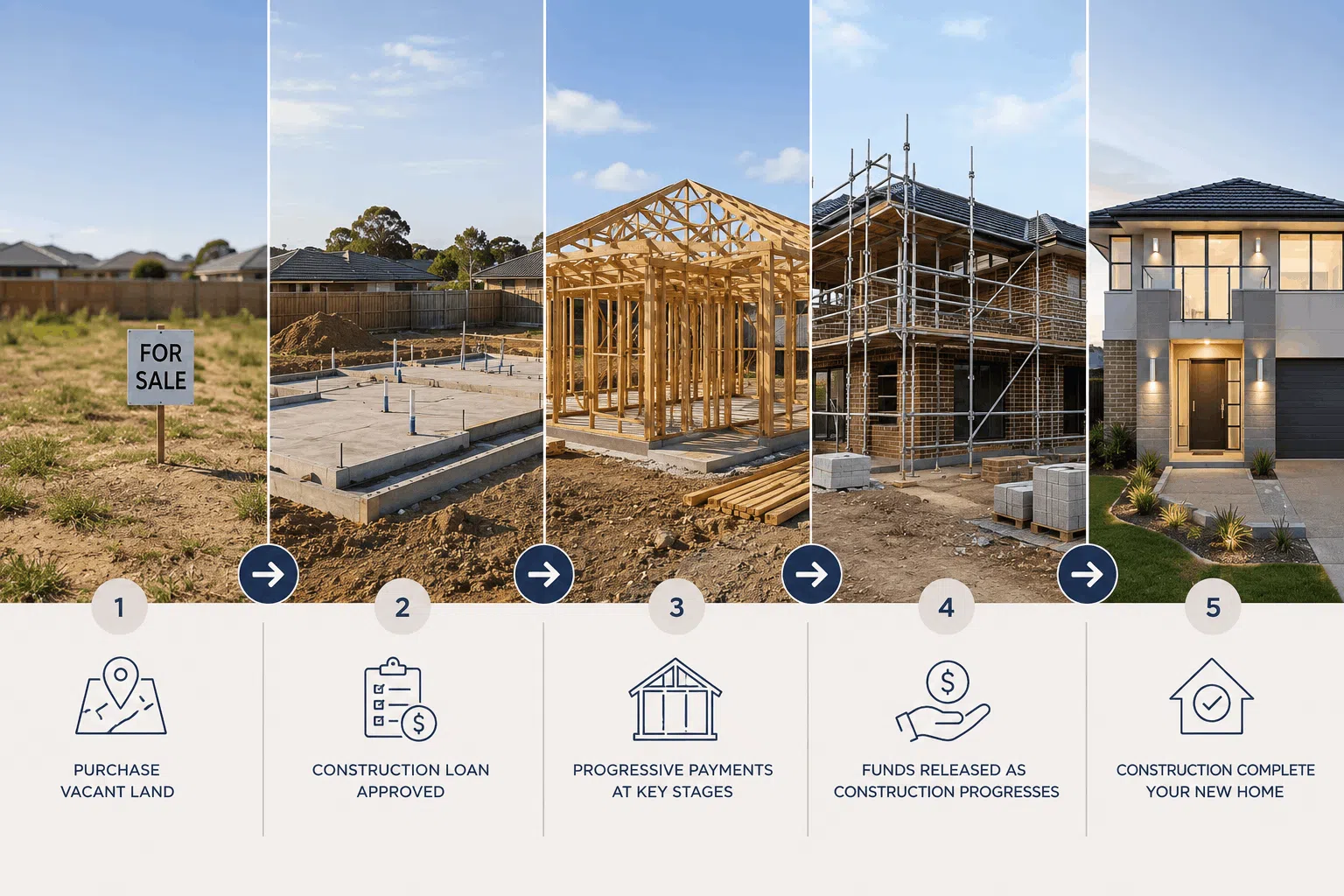
A land and construction loan follows a structured process, with different milestones determining when funds are released and when repayments change. Lender policies vary slightly, but the overall sequence is consistent.
Step 1: Purchase the Land
The first stage finances the land itself. The lender assesses the borrower’s financial position, the property’s value, and the proposed building plans before approving finance. Settlement proceeds similarly to a standard home purchase. Some borrowers proceed to construction almost immediately. Others purchase land months before building begins.
Step 2: Finalise Your Builder and Plans
Before construction finance can start, lenders generally require:
- A fixed-price building contract.
- Approved building plans.
- Council approvals where applicable.
- Builder details and relevant licences.
- Insurance documentation.
This stage gives lenders confidence that the project has been properly costed and can be completed within the approved budget.
One detail most articles overlook is that lenders assess the builder almost as carefully as they assess the borrower. A licensed builder with a solid track record supports a smoother approval process than an incomplete or uncertain building arrangement.
Step 3: Property Valuation
Rather than valuing the vacant land alone, lenders commission an “as if complete” valuation estimating what the finished property will be worth once construction ends.
That completed value determines:
- Maximum borrowing capacity.
- Loan to Value Ratio (LVR).
- Whether lenders mortgage insurance applies.
- Overall lending risk.
Two identical construction budgets can produce different lending outcomes when the completed property values differ. Many borrowers focus entirely on construction costs, but lenders place equal weight on the completed market value. An overly optimistic end valuation could affect borrowing capacity or require additional contributions prior to approval.
What Is the Process for a Construction Loan?
The construction loan process begins once all lending conditions have been satisfied and construction is ready to start.
The approved loan is divided into different phases. Only after each stage has been completed and verified are the funds released.
Construction Stage | Typical Work Completed |
Deposit | Initial builder deposit |
Base | Completed slab and foundations |
Frame | Structural framework erected |
Lock Up | External walls, roof, windows and doors fitted |
Fit Out | Finished interior plaster, cabinetry, electrical and plumbing |
Practical Completion | Completion of remaining work and final inspection |
After each stage:
- The builder submits a progress claim.
- The lender examines the claim.
- An inspection may be arranged.
- Funds are released directly to the builder.
Interest is charged only on the amount already drawn. If the total approved facility is $500,000 but only $120,000 has been released during early stages, interest is calculated on the $120,000 rather than the full amount. That reduces repayments considerably while construction is underway.
Why Do Lenders Disburse Funds in Stages?
Staged funding protects the lender, borrower and builder all at the same time. For lenders it reduces the risk of paying for incomplete work. For borrowers, payments closely follow actual construction progress. It gives builders a predictable flow of cash throughout the project.
Staged funding also surfaces problems earlier. If construction falls behind schedule or unexpected variations arise, there is still time to address them before the project reaches completion.
Many general guides do not explain that delays in the construction loan process rarely come from finance being declined. They come from invoices, inspection reports, or progress claims not being submitted on time. Keeping the borrower, builder, and lender aligned throughout the build prevents administrative issues from becoming construction delays.
How Does the Progress Payment Schedule Work?
The progress payment schedule states when the builder will be paid during construction. The lender does not fund the entire amount of the contract up front, instead, funds are disbursed following each agreed milestone completion and inspection (if required).
Stage | Typical Payment |
Deposit | 5% |
Base | 10–15% |
Frame | 15–20% |
Lock Up | 20–25% |
Fit Out | 25–30% |
Practical Completion | Remaining balance |
When a builder submits a progress claim, the lender will look at the documents and may organise an inspection before releasing payment.
Payment may be delayed by late invoices or incomplete documentation from the builder. A brief administrative lapse has an impact on subcontractor pay and the overall construction timeline.
One misconception that should be clarified is that lender inspections are not quality inspections. They confirm that the claimed stage has been completed so funds can be released. Workmanship disputes are managed separately between the homeowner and builder under the building contract.
Can You Get Low Doc Land and Construction Loans?
Low doc land and construction loans are available, and they are evaluated differently than regular home loans. Lenders may accept alternative income verification for eligible self-employed borrowers instead of relying on PAYG income and full tax returns.
Acceptable documents vary by lender but may include:
- Business Activity Statements.
- Accountant declarations.
- Business bank statements.
- Recent business financial records.
- Asset and liability statements.
At VOXFIN, we regularly assist self-employed borrowers who expect they need two full years of financial statements before applying. Some lenders still require comprehensive documentation. Specialist lenders may offer more flexible assessments where the overall application demonstrates financial strength.
Low doc land and construction loans do not mean no assessment. Lenders will still look at affordability, viability of the project, credit history and the proposed construction before granting finance.
Are Low Doc Vacant Land Loans Available?
Depending on the lender’s policies and the circumstances, low doc vacant land loans may also be available to consumers who are purchasing land before they can start building.
These loans are commonly suitable for:
- Small business owners.
- Self-employed business owners.
- Contractors with fluctuating income.
- Applicants having other sources of income.
Some borrowers buy land and start construction almost immediately. Others elect to live on the land while they wait for development approval, final building plans or builder availability.
Most lenders want construction to begin within a certain period of time after land settlement. Where significant delays occur, the borrower may need to discuss revised arrangements with the lender before that deadline passes.
What Should Borrowers Know About Vacant Land Loans in Australia?
Vacant land loans in Australia are available through major banks and specialist lenders, but policies differ considerably depending on the property’s location, size, and intended use.
For residential building blocks within established estates, lenders often apply similar policies to standard residential lending.
Additional assessment may apply where the land is:
- Larger than standard residential allotments.
- Located in regional or remote areas.
- Without immediate road access or services.
- Zoned differently from standard residential.
- Intended for future subdivision or development.
It is vital that borrowers budget for additional costs beyond the land purchase itself, such as site preparation costs, council contributions, utility connections and construction contingencies. These costs are consistently under-estimated in the planning phase, leading to a funding gap for borrowers at settlement.
An in-depth feasibility analysis prior to purchasing the land provides a much better idea of the total cost of the project than just the cost of the purchase.
What Should Melbourne Buyers Consider When Financing Vacant Land?
There is a growing interest in vacant land loans in Melbourne’s outer growth corridors as people buy land before they build. Borrowers looking for vacant land loans should not just consider the interest rates. Interest rates matter, but they are rarely the primary cause of construction delays.
Other important factors are:
- Timetables for land registration within the Estate.
- The lender required deadlines for construction to start.
- Council approval processes and expected timeframes.
- Availability of builders and fixed-price contract expiry periods.
- Design guidelines and building requirements specific to the estate.
The small differences in loan pricing cause far less disruption than incomplete documentation, expired building quotes and poorly coordinated settlement dates. Borrowers who combine finance, builder selection and construction scheduling at the outset experience fewer delays than borrowers who separate each stage.
What Mistakes Can Delay a Land and Construction Loan?
Most delayed approvals are due to poor project preparation rather than bad credit or low income.
Common problems include:
- Application prior to finalising building plans.
- Underestimation of the total construction cost.
- Change in design after formal approval.
- Delays in progress claims during construction.
- Forgetting to budget for site works and contingencies.
- Selecting a builder before confirming lender requirements.
A well-prepared application allows lenders to assess the project with greater confidence and produces a smoother process from application through to practical completion.
At VOXFIN, we review both the finance application and the construction documentation before approaching lenders. That review identifies potential issues early and reduces the likelihood of avoidable delays during the build.
Secure Finance With Greater Confidence
Conclusion
Understanding how a land and construction loan works makes the building process considerably less stressful. Every step of the way, from land acquisition to managing the construction loan process and a progress payment schedule, is directly responsible for keeping the project on track.
If you are buying your first block of land, planning a custom home or exploring low doc land and construction loans, choosing the right lending structure from the start will save you time and unnecessary cost. At VOXFIN, we assist Australians to navigate complex lending situations, compare suitable lenders and structure finance that aligns with their building goals. If you’re thinking about building, our team can help you understand your options before construction begins.
FAQs
Can I use my existing land as equity for a construction loan?
Yes. Where there is sufficient equity in land already owned, many lenders allow that equity to count towards construction costs instead of requesting for an extra cash deposit. The equity you can tap depends on what the land is worth, the debt you already have and the policies of the lender.
What happens if my builder charges more than the original contract price?
Design changes or unforeseen site conditions are common reasons for construction variations. If your approved loan does not cover the extra costs then generally you will have to fund these yourself or apply for additional finance subject to lender approval and updated affordability assessments.
Can I make extra repayments during construction?
Many lenders will allow you to make voluntary extra repayments during construction depending on the loan product. Any extra repayments you make will reduce the amount of interest charged as interest is charged on funds drawn, not on the total limit approved.
How long does a land and construction loan approval usually take?
The length of time will depend on the lender, the documentation and the complexity of the project. Applications that have the full building contract and supporting documentation will be processed more quickly than those that require further valuations, council approval or specialist lending assessments.

